

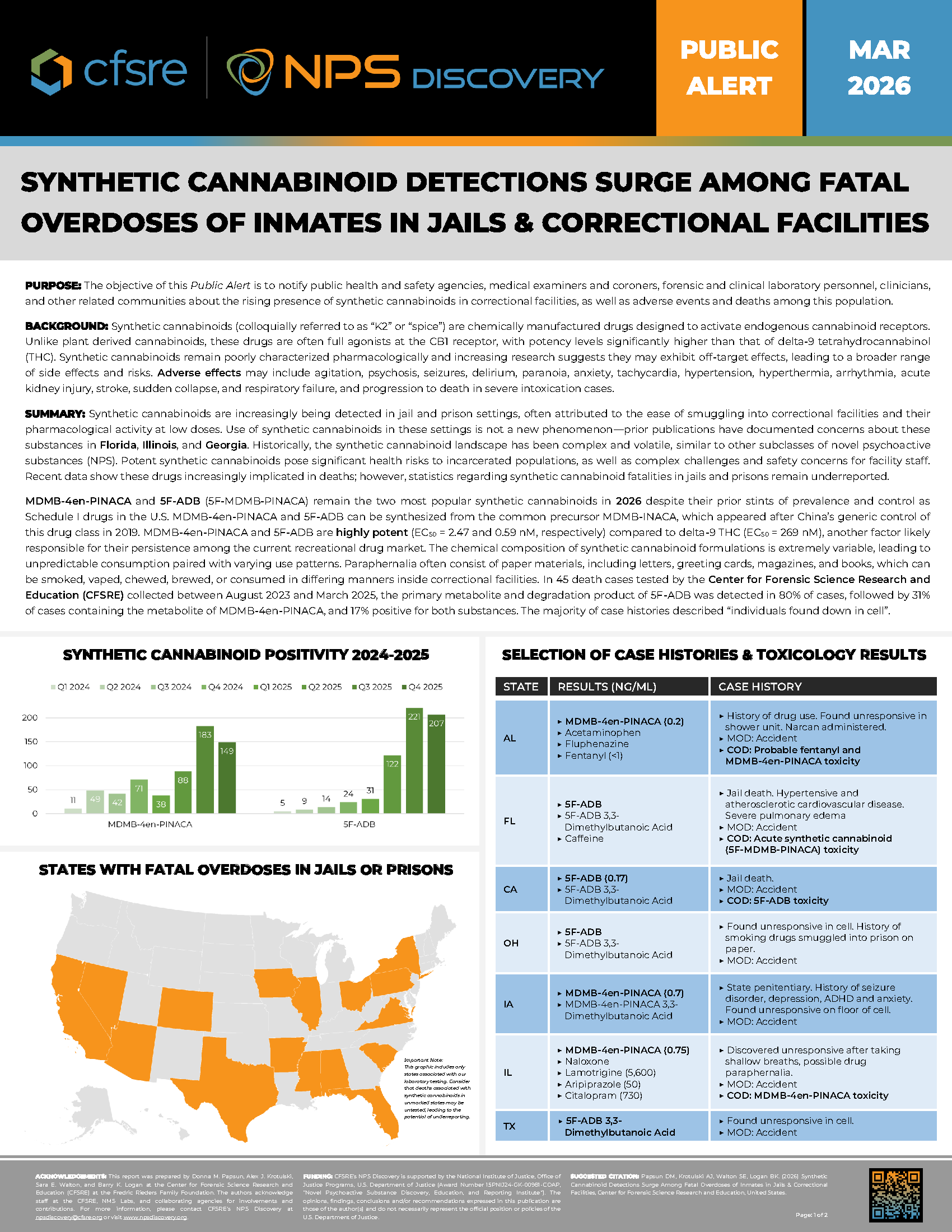
Synthetic cannabinoids are increasingly being detected in jail and prison settings, often attributed to the ease of smuggling into correctional facilities and their pharmacological activity at low doses. Use of synthetic cannabinoids in these settings is not a new phenomenon—prior publications have documented concerns about these substances in Florida, Illinois, and Georgia. Historically, the synthetic cannabinoid landscape has been complex and volatile, similar to other subclasses of novel psychoactive substances (NPS). Potent synthetic cannabinoids pose significant health risks to incarcerated populations, as well as complex challenges and safety concerns for facility staff. Recent data show these drugs increasingly implicated in deaths; however, statistics regarding synthetic cannabinoid fatalities in jails and prisons remain underreported.
MDMB-4en-PINACA and 5F-ADB (5F-MDMB-PINACA) remain the two most popular synthetic cannabinoids in 2026 despite their prior stints of prevalence and control as Schedule I drugs in the U.S. MDMB-4en-PINACA and 5F-ADB can be synthesized from the common precursor MDMB-INACA, which appeared after China’s generic control of this drug class in 2019. MDMB-4en-PINACA and 5F-ADB are highly potent (EC50 = 2.47 and 0.59 nM, respectively) compared to delta-9 THC (EC50 = 269 nM), another factor likely responsible for their persistence among the current recreational drug market. The chemical composition of synthetic cannabinoid formulations is extremely variable, leading to unpredictable consumption paired with varying use patterns. Paraphernalia often consist of paper materials, including letters, greeting cards, magazines, and books, which can be smoked, vaped, chewed, brewed, or consumed in differing manners inside correctional facilities. In 45 death cases tested by the Center for Forensic Science Research and Education (CFSRE) collected between August 2023 and March 2025, the primary metabolite and degradation product of 5F-ADB was detected in 80% of cases, followed by 31% of cases containing the metabolite of MDMB-4en-PINACA, and 17% positive for both substances. The majority of case histories described “individuals found down in cell”.