

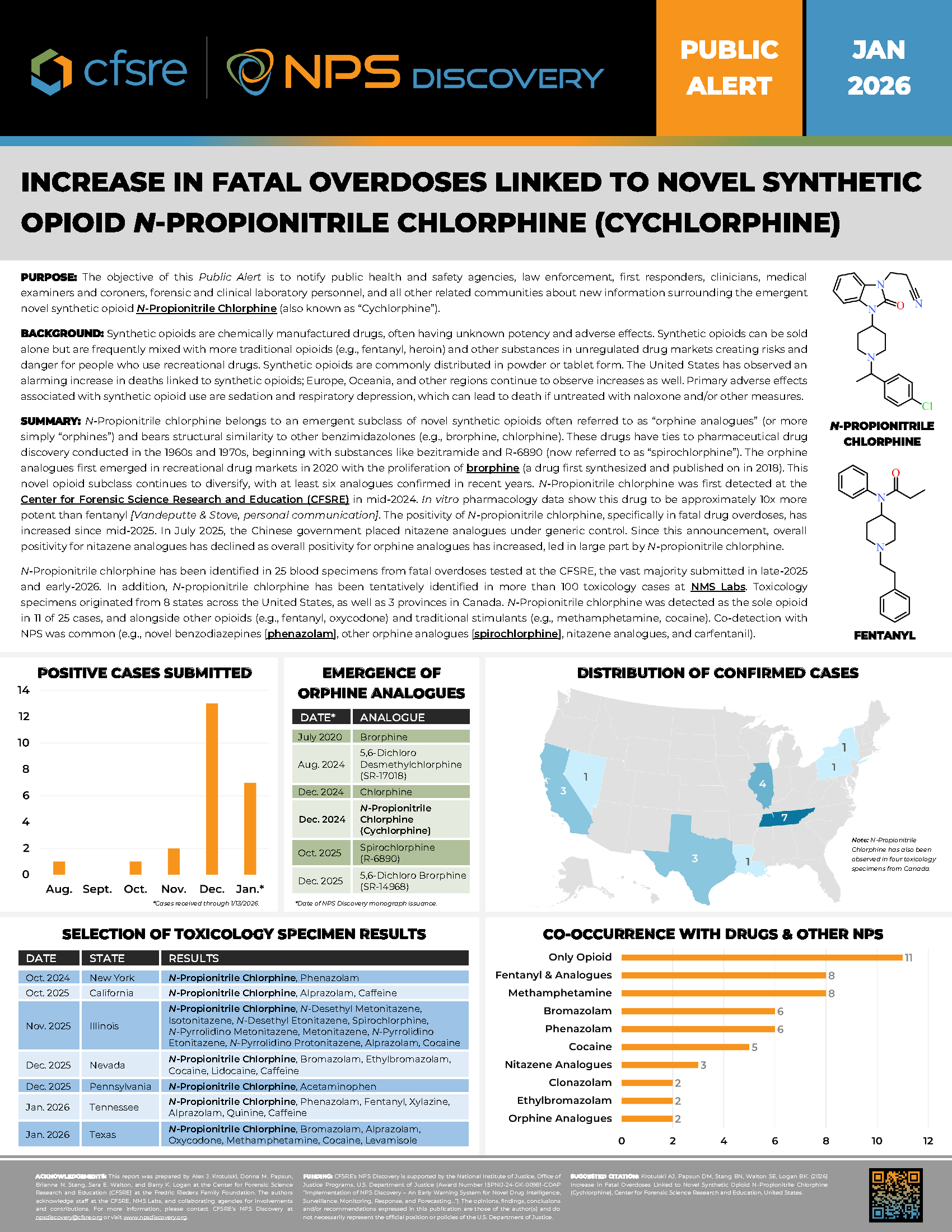
N-Propionitrile chlorphine belongs to an emergent subclass of novel synthetic opioids often referred to as “orphine analogues” (or more simply “orphines”) and bears structural similarity to other benzimidazolones (e.g., brorphine, chlorphine). These drugs have ties to pharmaceutical drug discovery conducted in the 1960s and 1970s, beginning with substances like bezitramide and R-6890 (now referred to as “spirochlorphine”). The orphine analogues first emerged in recreational drug markets in 2020 with the proliferation of brorphine (a drug first synthesized and published on in 2018). This novel opioid subclass continues to diversify, with at least six analogues confirmed in recent years. N-Propionitrile chlorphine was first detected at the Center for Forensic Science Research and Education (CFSRE) in mid-2024. In vitro pharmacology data show this drug to be approximately 10x more potent than fentanyl [Vandeputte & Stove, personal communication]. The positivity of N-propionitrile chlorphine, specifically in fatal drug overdoses, has increased since mid-2025. In July 2025, the Chinese government placed nitazene analogues under generic control. Since this announcement, overall positivity for nitazene analogues has declined as overall positivity for orphine analogues has increased, led in large part by N-propionitrile chlorphine.
N-Propionitrile chlorphine has been identified in 25 blood specimens from fatal overdoses tested at the CFSRE, the vast majority submitted in late-2025 and early-2026. In addition, N-propionitrile chlorphine has been tentatively identified in more than 100 toxicology cases at NMS Labs. Toxicology specimens originated from 8 states across the United States, as well as 3 provinces in Canada. N-Propionitrile chlorphine was detected as the sole opioid in 11 of 25 cases, and alongside other opioids (e.g., fentanyl, oxycodone) and traditional stimulants (e.g., methamphetamine, cocaine). Co-detection with NPS was common (e.g., novel benzodiazepines [phenazolam], other orphine analogues [spirochlorphine], nitazene analogues, and carfentanil).