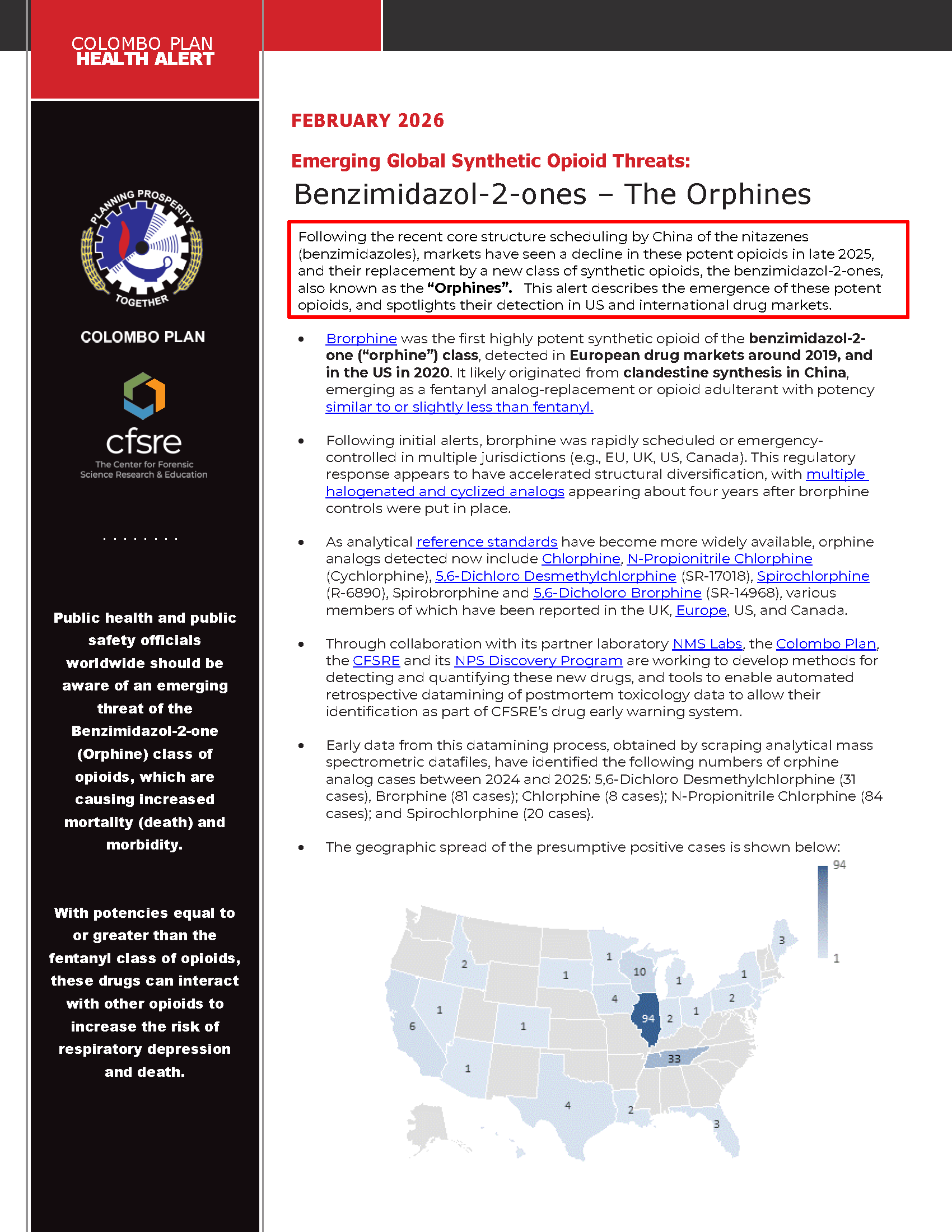

Following the recent core structure scheduling by China of the nitazenes (benzimidazoles), markets have seen a decline in these potent opioids in late 2025, and their replacement by a new class of synthetic opioids, the benzimidazol-2-ones, also known as the “Orphines”. This alert describes the emergence of these potent opioids, and spotlights their detection in US and international drug markets.
---Brorphine was the first highly potent synthetic opioid of the benzimidazol-2-one (“orphine”) class, detected in European drug markets around 2019, and in the US in 2020. It likely originated from clandestine synthesis in China, emerging as a fentanyl analog-replacement or opioid adulterant with potency similar to or slightly less than fentanyl.
---Following initial alerts, brorphine was rapidly scheduled or emergency-controlled in multiple jurisdictions (e.g., EU, UK, US, Canada). This regulatory response appears to have accelerated structural diversification, with multiple halogenated and cyclized analogs appearing about four years after brorphine controls were put in place.
---As analytical reference standards have become more widely available, orphine analogs detected now include Chlorphine, N-Propionitrile Chlorphine (Cychlorphine), 5,6-Dichloro Desmethylchlorphine (SR-17018), Spirochlorphine (R-6890), Spirobrorphine and 5,6-Dicholoro Brorphine (SR-14968), various members of which have been reported in the UK, Europe, US, and Canada.
January 30, 2026
Emerging Global Synthetic Opioid Threats: Benzimidazol-2-ones – The Orphines